
Lot 101




Jean François de Troy
1679 - 1752, attributed
Two Muses
France
18th century
Oil on canvas
74.5 x 104.5 cm, with frame 93.5 x 122.5 cm
Label on the back
Jean François de Troy is considered one of the most versatile and significant French painters of the early 18th century. As the son of the renowned portraitist François de Troy, he received his initial training in his father’s studio before a prolonged stay in Italy (1699 - 1706) had a decisive influence on him. In 1708, he was admitted to the Académie royale, and in 1738 he was appointed director of the Académie de France in Rome, where he worked until his death. De Troy was highly regarded both as a portraitist and as a creator of historical paintings, mythological and religious scenes, and elegant genre depictions. His painting combines the decorative richness and colorfulness of a Paolo Veronese with the dynamic sensuality of a Peter Paul Rubens. Contemporaries regarded him as one of France’s leading painters, whose work contributed significantly to the development of French painting in the 18th century.
The theme of the Muses originates in ancient mythology: as daughters of Zeus and Mnemosyne, they embody the arts and sciences. In European art of the 17th and 18th centuries, they frequently appear in allegorical depictions that combine both decorative and intellectual aspirations. While the muse of love poetry—Erato—and the muse of choral poetry and dance—Terpsichore—as well as the muse of song—Polyhymnia—are often depicted with musical instruments, the muse of historiography—Clio—and the muse of epic poetry – Kalliope – are frequently accompanied by attributes of intellectual creation, such as a stylus and a scroll. Such combinations point to the harmonious interplay of music and poetry, two closely related arts.
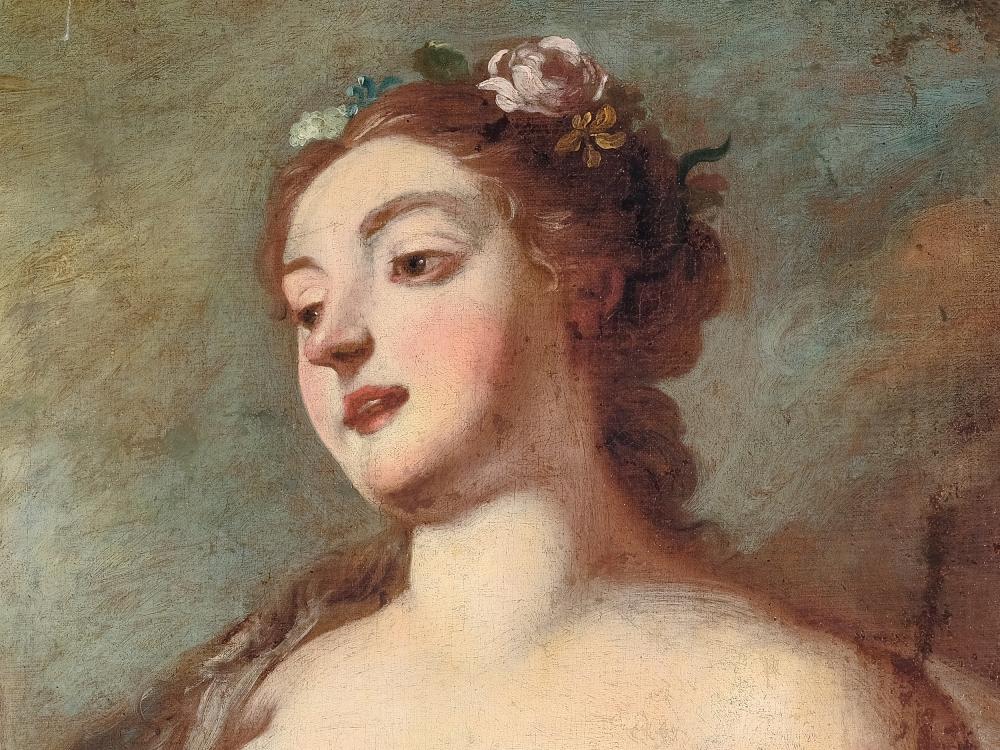
This painting depicts two female figures facing each other and apparently communicating against a dynamic, cloudy sky. In the right half of the painting appears the muse of music, likely Euterpe, half - naked, covered only by a white robe draped lightly over her shoulders. Flowers are woven into her artfully braided hair, including a delicate pink rose. In her right hand she holds a rolled - up sheet of music, while with her left she embraces a lyre; a violin can be seen beside her. With raised eyebrows, open eyes, and a slightly parted mouth, she faces her companion in three - quarter profile, as if engaged in a lively exchange.
The second muse on the left side of the painting is also depicted in three - quarter profile and turns toward the first. Her braided brown hair is adorned with laurel leaves, a classic attribute of poetic inspiration. She partially bares one breast, while a blue cloak is loosely draped over her gown. With her left hand, she plucks the strings of the instrument, while she supports herself with her right elbow and writes with a stylus on a sheet of paper on which several lines are already visible.
This work is a high - quality variation on a painting by de Troy in the New Orleans Museum of Art. The attribution is further supported by stylistic comparisons with other confirmed works by the artist, such as the Allégorie de la Force et de la Tempérance at the Château d’Aulteribe (Sermentizon). There, comparable poses of the figures, a similar treatment of the garments with their luminous colors, and a similarly constructed, softly modeled sky are evident. The facial features of the figures—particularly those of the muse on the right—as well as the finely rendered flesh tones also exhibit clear parallels. The combination of two allegorical figures further aligns with the artist’s practice of creating pairs centered on morally or intellectually charged themes.
De Troy’s painting is characterized by an elegant, flowing brushstroke and a rich yet harmonious color palette. His compositions combine decorative grace with narrative clarity and reflect the transition from the austere history painting of the 17th century to the lighter, gallant compositions of the 18th century. Despite growing criticism of allegorical representations over the course of the century—for instance by Abbé Du Bos or Denis Diderot—the genre remained in demand due to its representational and intellectual qualities. Works such as this one demonstrate the enduring fascination with allegorical themes, which in de Troy’s hands achieve a particular elegance and artistic refinement.
Bibliography: Christophe Leribault, Alastair Laing, Jean - François de Troy, 1679 - 1752, Paris, Arthéna, 2002.
Jean François de Troy
1679 - 1752, zugeschrieben
Zwei Musen
Frankreich
18. Jahrhundert
Öl auf Leinwand
74,5 x 104,5 cm, mit Rahmen 93,5 x 122,5 cm
Rückseitig Etikett
Jean François de Troy zählt zu den vielseitigsten und bedeutendsten französischen Malern des frühen 18. Jahrhunderts. Als Sohn des renommierten Porträtisten François de Troy erhielt er seine erste Ausbildung im väterlichen Atelier, bevor ihn ein längerer Aufenthalt in Italien (1699-1706) entscheidend prägte. 1708 wurde er in die Académie royale aufgenommen, 1738 zum Direktor der Académie de France in Rom ernannt, wo er bis zu seinem Tod wirkte. De Troy war sowohl als Porträtist als auch als Schöpfer von Historienbildern, mythologischen und religiösen Szenen sowie eleganten Genredarstellungen geschätzt. Seine Malerei verbindet den dekorativen Reichtum und die Farbigkeit eines Paolo Veronese mit der dynamischen Sinnlichkeit eines Peter Paul Rubens. Zeitgenossen betrachteten ihn als einen der führenden Maler Frankreichs, dessen Werk wesentlich zur Entwicklung der französischen Malerei im 18. Jahrhundert beitrug.
Das Thema der Musen entstammt der antiken Mythologie: Als Töchter des Zeus und der Mnemosyne verkörpern sie die Künste und Wissenschaften. In der europäischen Kunst des 17. und 18. Jahrhunderts erscheinen sie häufig in allegorischen Darstellungen, die sowohl dekorativen als auch intellektuellen Anspruch vereinen. Während die Muse der Liebesdichtung – Erato – und die Muse für Chorlyrik und Tanz – Terpsichore – sowie die Muse des Gesangs – Polyhymnia – oft durch Musikinstrumente gekennzeichnet sind, werden die Muse der Geschichtsschreibung – Klio – und die Muse der epischen Dichtung – Kalliope – häufig durch Attribute des geistigen Schaffens begleitet, etwa durch einen Schreibgriffel und ein Schriftstück. Solche Kombinationen verweisen auf das harmonische Zusammenspiel von Musik und Dichtung, zwei eng miteinander verbundene Künste.
Das vorliegende Gemälde zeigt zwei einander zugewandte, offenbar kommunizierende weibliche Figuren vor einer bewegten, wolkigen Himmelslandschaft. In der rechten Bildhälfte erscheint die Muse der Musik, wohl Euterpe, halb entblößt, lediglich von einem leicht über die Schultern fallenden weißen Gewand bedeckt. In ihrem kunstvoll geflochtenen Haar sind Blumen eingeflochten, darunter eine zarte rosafarbene Rose. In ihrer rechten Hand hält sie ein zusammengerolltes Notenblatt, während sie mit der linken eine Leier umfasst; daneben ist eine Violine zu erkennen. Mit erhobenen Augenbrauen, geöffneten Augen und leicht geöffnetem Mund ist sie im Dreiviertelprofil ihrer Gefährtin zugewandt, als befände sie sich im lebhaften Austausch.
Die zweite Muse in der linken Bildhälfte ist ebenfalls im Dreiviertelprofil dargestellt und wendet sich der ersten zu. Ihr geflochtenes braunes Haar ist mit Lorbeerblättern geschmückt, einem klassischen Attribut dichterischer Inspiration. Sie entblößt eine Brust teilweise, während ein blauer Mantel locker über ihr Gewand gelegt ist. Mit der linken Hand greift sie in die Saiten des Instruments, während sie sich mit dem rechten Ellbogen aufstützt und mit einem Schreigriffel auf ein Blatt schreibt, auf dem bereits einige Zeilen sichtbar sind.
Bei dem vorliegenden Werk handelt es sich um eine qualitätvolle Variation eines Gemäldes von de Troy im New Orleans Museum of Art. Die Zuschreibung ergibt sich außerdem aus stilistischen Vergleichen mit weiteren gesicherten Werken des Künstlers, wie etwa der Allégorie de la Force et de la Tempérance im Château d’Aulteribe (Sermentizon). Dort zeigen sich vergleichbare Figurenhaltungen, eine ähnliche Behandlung der Gewänder mit ihrer leuchtenden Farbigkeit sowie ein analog aufgebauter, weich modellierter Himmel. Auch die Gesichtszüge der Figuren – insbesondere der rechten Muse – sowie die fein ausgearbeitete Inkarnatmalerei weisen deutliche Parallelen auf. Die Kombination zweier allegorischer Figuren entspricht zudem der Praxis des Künstlers, Pendants mit moralisch oder intellektuell aufgeladenen Themen zu schaffen.
De Troys Malerei zeichnet sich durch eine elegante, fließende Pinselführung und eine reiche, zugleich harmonische Farbpalette aus. Seine Kompositionen verbinden dekorative Anmut mit erzählerischer Klarheit und spiegeln den Übergang von der strengen Historienmalerei des 17. Jahrhunderts zu den leichteren, galanten Bildfindungen des 18. Jahrhunderts wider. Trotz der im Laufe des Jahrhunderts zunehmenden Kritik an allegorischen Darstellungen – etwa durch den Abbé Du Bos oder Denis Diderot – blieb das Genre aufgrund seiner repräsentativen und intellektuellen Qualitäten weiterhin gefragt. In Werken wie dem vorliegenden zeigt sich die anhaltende Faszination für allegorische Themen, die in de Troys Händen eine besondere Eleganz und künstlerische Raffinesse erreichen.
Literatur: Christophe Leribault, Alastair Laing, Jean-Franc̦ois de Troy, 1679-1752, Paris, Arthéna, 2002.
Accepted Forms of Payment:
Wire Transfer
Shipping
TIBERIUS-AUCTIONS does not offering shipping. We provide a list of trusted local and International professionals who have offered their services.
Worldwide shipping:
Mail Boxes Etc.
Teichmann OG
Lamezanstraße 9
Tel. +43 1 996 94 87 - 0
[email protected]
Worldwide shipping:
Pack&Weg!
Kettenbrückengasse 5, 1050 Wien
Tel. +43 720 552 727 550
[email protected]
Austria:
Pempertransports
Perfektastraße 81, 1230 Wien
Tel. +43 650 40 20 108
[email protected]
Germany, Switzerland, Netherlands, France, Belgium, Scandinavia:
Fegers GmbH Service for Art and Trade
Moldenweg 5
D-21339 Lüneburg
Tel. +49 4131 727 525
Mobil +49 171 770 50 18
[email protected]
Italy, Spain, Portugal, France and Benelux:
Gugel srl
Via Papa Giovanni XXIII
31020 Sernaglia d. Batt
Tel. +39 335 52 73 742
[email protected]
TIBERIUS-AUCTIONS will not release items to any shipper until your auction invoice has been paid.
All items must be picked up, or shipping arrangements made, within three weeks of the day of sale. NOTE: Items left here more than three weeks will incur storage fees at a rate of € 10.00 per lot per day (this rate applies to all items regardless of size or value).
Tiberius Auctions
You agree to pay a buyer's premium of 28% and any applicable taxes and shipping.
View full terms and conditions
| From: | To: | Increments: |
|---|---|---|
| €0 | €99 | €5 |
| €100 | €199 | €10 |
| €200 | €399 | €20 |
| €400 | €999 | €50 |
| €1,000 | €1,999 | €100 |
| €2,000 | €3,999 | €200 |
| €4,000 | €9,999 | €500 |
| €10,000 | €19,999 | €1,000 |
| €20,000 | €39,999 | €2,000 |
| €40,000 + | €5,000 |